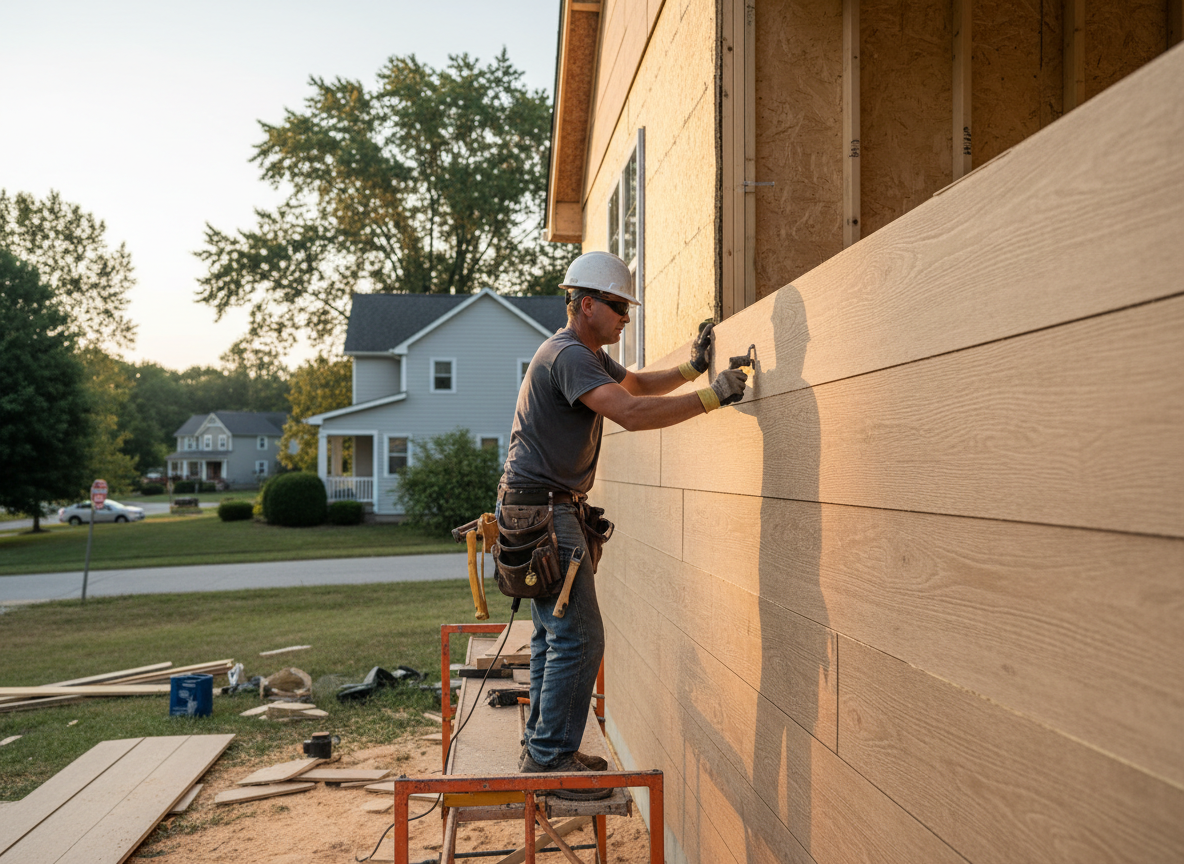
Hardboard siding appears on many mid-century homes in Anderson Township and nearby Mount Washington and Forest Hills. This material expands and contracts with the humidity that rolls up from the Ohio River and the repeated freeze-thaw cycles that hit Hamilton County each winter. When water gets behind the boards through cracked caulk or poorly flashed windows, the siding softens and the sheathing begins to rot within a single season.
Proper installation here requires 3/8-inch gaps at all joints, stainless-steel fasteners every six inches along edges, and a continuous drainage plane behind the boards. Anderson Township homes often sit on sloped lots where runoff pools against the foundation; skipping the Z-flashing at the base lets water wick upward and destroy the lower courses first. Homeowners frequently mistake surface mildew for the real problem and apply paint that traps more moisture inside the wall.
Local building practices in Cincinnati call for a minimum 6-inch clearance above grade and proper termination of the housewrap at all penetrations. When replacing sections, we match the original 7/16-inch thickness and prime every cut edge before installation. Skipping these steps in our climate leads to callbacks within two years.
Technician insight
In Anderson Township the thing that catches most people out with hardboard siding is water sitting against the foundation on sloped lots after heavy spring rains; the lower two courses soak it up first and the rot travels upward behind the boards before any exterior sign shows.
Lower Course Replacement on a Beechmont Ave Split-Level
Hardboard along the front had softened and paint was peeling after repeated winter thaws. We found saturated OSB sheathing and failed housewrap behind the bottom three feet. We cut out the damaged area, replaced the sheathing, added new Z-flashing at grade, and reinstalled matching hardboard with full edge priming. The wall has stayed dry through the following two seasons.
How it works
- 1
Initial Inspection
We examine every board for softness, check flashing details, and probe for hidden rot behind the siding on Anderson Township homes.
- 2
Moisture Assessment
Using a meter we map wet areas, identify failed housewrap, and note drainage issues common on sloped lots near Beechmont Ave.
- 3
Section Removal
Damaged hardboard is cut out cleanly, rotted sheathing is replaced, and the wall is dried before new material goes up.
- 4
Reinstallation and Sealing
New hardboard is installed with proper gaps, primed edges, and new flashing at windows and the foundation line.
- 5
Final Finish
All joints are caulked with paintable sealant rated for freeze-thaw exposure and the surface is primed for the homeowner's chosen color.
Pricing
Cost depends on square footage affected, extent of hidden rot, and whether only sections or full elevations are replaced; we provide upfront written quotes after inspection.