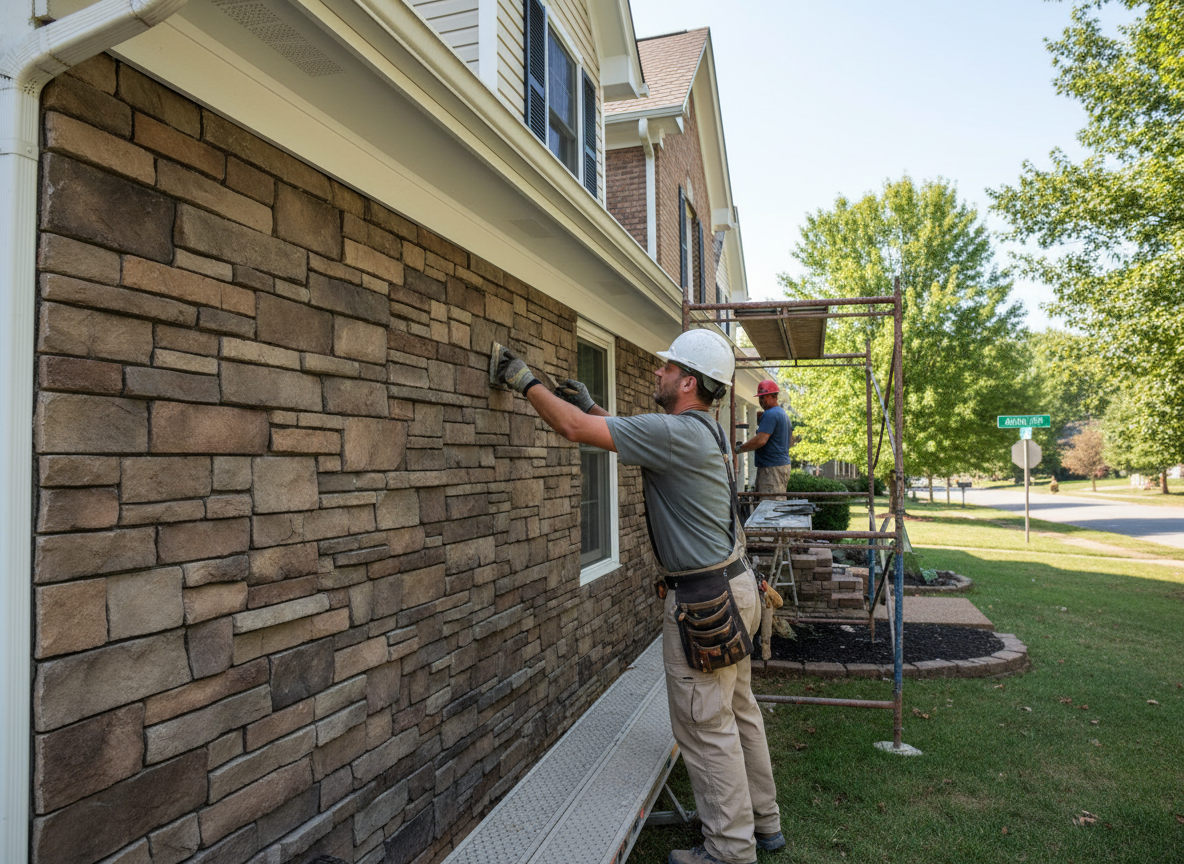
Faux stone siding requires precise substrate preparation on Anderson Township homes, many of which date to the 1960s and 1970s with wood or brick sheathing that can shift with seasonal ground movement along the Ohio River valley. Proper moisture barriers and ventilation prevent trapped condensation that accelerates rot behind panels during humid summers and freeze-thaw winters. Edge detailing around windows and doors must account for the thermal expansion common in Hamilton County homes exposed to wide temperature swings.
Installation crews at Spark Patch match panel profiles to the scale of local ranch and split-level houses while maintaining proper weep holes and starter strips to shed water away from foundations. Older neighborhoods near Beechmont Avenue often feature uneven terrain that demands custom leveling before panels are hung. Skipping these steps leads to visible gaps and callbacks within two seasons.
Local Weather Considerations
Faux stone siding in Anderson Township must handle heavy spring rains and winter ice that drive water behind poorly sealed joints. We route flashing to direct runoff over existing gutters rather than into siding seams, a detail that protects the many homes built on sloped lots near the Little Miami River corridor.
Material Compatibility Notes
Homeowners frequently request faux stone to cover dated aluminum or vinyl without full tear-off. Our process checks for underlying sheathing integrity first, because adding weight to compromised framing in older Cincinnati suburbs creates long-term movement issues that only appear after the first hard freeze.
Technician insight
In Anderson Township the thing that catches most people out with faux stone siding is the combination of older wood sheathing and our freeze-thaw winters; if the original house wrap is brittle, water gets behind the new panels within the first season and the only fix is pulling everything back off.
Faux Stone Repair on Beechmont-Area Home
Homeowner in Anderson Township reported bulging panels near the garage after a wet winter. Inspection showed failed flashing at the roofline allowing water to pool. We removed the damaged section, replaced the wrap and flashing, then reinstalled matching panels. The siding now sheds water correctly and the homeowner has not seen further movement.
How it works
- 1
Site Assessment
Walk the full exterior to check sheathing, flashing, and drainage on the specific Anderson Township property.
- 2
Substrate Preparation
Repair or replace damaged areas and install moisture barriers suited to local freeze-thaw exposure.
- 3
Panel Layout and Installation
Hang panels with correct spacing and fasteners, maintaining alignment with existing rooflines and window trim.
- 4
Finishing and Cleanup
Apply sealants at joints, verify weep holes remain clear, and remove all debris from the job site.
Pricing
Upfront written quotes provided after on-site review; final cost depends on home size, existing condition, and material selection.